


Chinese President Hu Jintao (胡錦濤) arrived yesterday in North Korea for a rare visit, with the six-nation talks on the regime's nuclear program expected to top the agenda. As Hu touched down at Pyongyang's airport, he was greeted by reclusive leader Kim Jong-il.
"The China-North Korean friendship ... is conducive to safeguarding peace and stability and promoting development and prosperity in the region," Hu was quoted as saying on arrival.
Hu's three-day mission will be to convince his hosts of the need to stick to commitments they made in nuclear talks in Beijing last month, and China's own stake in the game ensures that he will be speaking forcefully, analysts said.
"This is critical to China's image as a rising power and its credibility and ability in delivering results," said Yuan Jing-dong, an expert on Asian non-proliferation at California's Monterey Institute of International Studies.
"But most important, failure would completely rupture the six-party process, which in turn could lead to further deterioration of the peninsular and indeed Northeast Asian security situation," he said.
The next round of six-party talks involving the two Koreas, China, Japan, Russia and the US is expected in the Chinese capital next month.
At the last round of six-nation talks, North Korea agreed to a statement of principles that could potentially end the prolonged standoff. Under the principles, North Korea would give up its nuclear weapons program in return for energy and security guarantees.
But soon after agreeing to the statement, Pyongyang said it would not dismantle its nuclear arsenal before the US supplies it with a light-water atomic reactor to generate electricity. The US says North Korea, a self-avowed nuclear power, must first disarm before getting incentive bonuses, including the nuclear reactor.
The signs that the entire deal could yet unravel may put Hu in an awkward situation, as it is likely he only agreed to visit the impoverished country after it promised to be more forthcoming.
"The North Koreans have been trying to get Hu to make a reciprocal visit for over a year but he had held off until the six-party talks were resumed," said Ralph Cossa, president of Honolulu-based think tank Pacific Forum CSIS. "I assume this was part of the `incentives' that got Pyongyang back to the table and then got them to sign the statement in September."
If North Korea backpedals at the next round, it could trigger the rage even of China, arguably its oldest and most reliable ally.
"China's patience is running thin," Cossa said. "The risk to Hu in going is that if North Korea plays games at the next round in early November, it also discredits China's and Hu's personal diplomacy skills."
While in Pyongyang, Hu is expected to air the idea of economic reform to Kim, pointing out China's experience and hinting that he cannot expect to depend on China's largess forever.
Economic reform is widely considered the only way out for a country suffering from decades of mismanagement, but it is hard to implement with a man like Kim at the top, experts said.
"Kim is paranoid on potential threats to his own legitimacy and the regime's, so he will try to fend off the idea even though he will try not to offend Hu," Yuan said. "In the longer term, a reforming North Korea, even if with ginger steps initially, will work to China's interests."
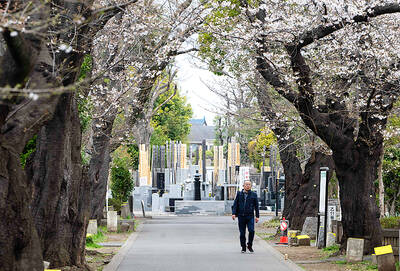
ROCKY RELATIONS: The figures on residents come as Chinese tourist numbers drop following Beijing’s warnings to avoid traveling to Japan The number of Chinese residents in Japan has continued to rise, even as ties between the two countries have become increasingly fractious, data released on Friday showed. As of the end of December last year, the number of Chinese residents had increased by 6.5 percent from the previous year to 930,428. Chinese people accounted for 22.6 percent of all foreign residents in Japan, making them by far the largest group, Japanese Ministry of Justice data showed. Beijing has criticized Tokyo in increasingly strident terms since Japanese Prime Minister Sanae Takaichi last year suggested that a military conflict around Taiwan could

Germany is considering Australia’s Ghost Bat robot fighter as it looks to select a combat drone to modernize its air force, German Minister of Defense Boris Pistorius said yesterday. Germany has said it wants to field hundreds of uncrewed fighter jets by 2029, and would make a decision soon as it considers a range of German, European and US projects developing so-called “collaborative combat aircraft.” Australia has said it will integrate the Ghost Bat, jointly developed by Boeing Australia and the Royal Australian Air Force, into its military after a successful weapons test last year. After inspecting the Ghost Bat in Queensland yesterday,
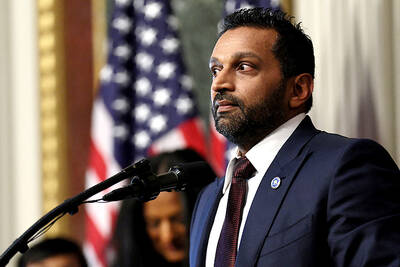
A pro-Iran hacking group claimed to breach FBI Director Kash Patel’s personal e-mail inbox and posted some of the contents online. The e-mails provided by the hacking group include travel details, correspondence with leasing agents in Washington and global entry, and loyalty account numbers. The e-mail address the hackers claim to have compromised has been previously tied to Patel’s personal details, and the leaked e-mails contain photos of Patel and others, in addition to correspondence with family members and colleagues. “The FBI is aware of malicious actors targeting Director Patel’s personal email information,” the agency said in a statement on
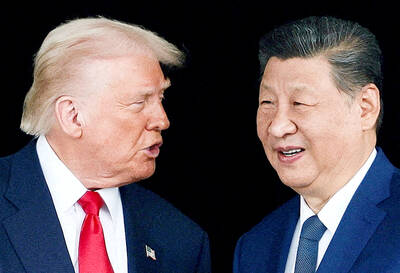
RIVALRY: ‘We know that these are merely symbolic investigations initiated by China, which is in fact the world’s most profligate disrupter of supply chains,’ a US official said China has started a pair of investigations into US trade practices, retaliating against similar probes by US President Donald Trump’s administration as the superpowers stake out positions before an expected presidential summit in May. The move, announced by the Chinese Ministry of Commerce on Friday, is a direct mirror of steps Trump took to revive his tariff agenda after the US Supreme Court last month struck down some of his duties. “China expresses its strong dissatisfaction and firm opposition to these actions,” a ministry spokesperson said in a statement, referring to the so-called Section 301 investigations initiated on March 11.


 RSS
RSS